
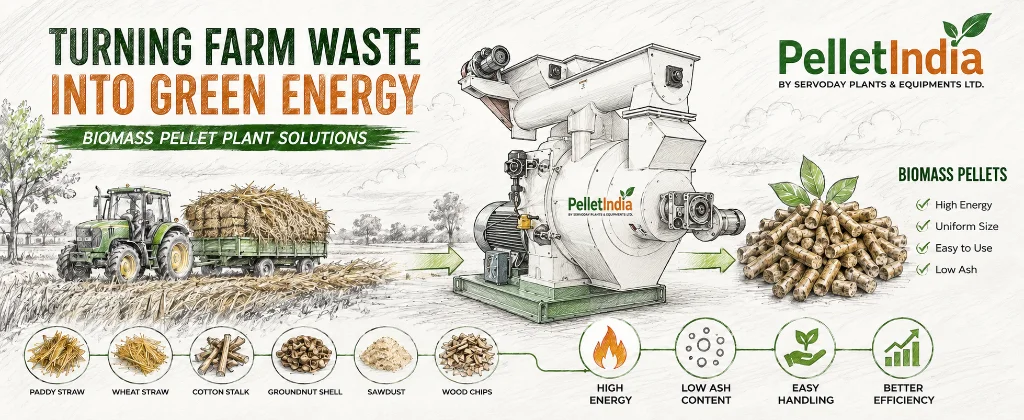
1. What is biomass?
Biomass means organic material produced from plants, crops, trees, agro-waste, and other natural sources. In India, a large quantity of biomass is available every year from farmers, sawmills, food processing units, and agro-industries.
Government/industry sources list common biomass materials such as paddy straw, sugarcane bagasse, press mud, rice husk, mustard husk, cotton stalk, coconut shell, soya husk, coffee waste, jute waste, groundnut shell, sawdust, and similar agro-residues.
Biomass can be used for:
2. Biomass materials available from farmers
A. Crop residues
| Biomass Material | Source | Pellet Suitability | Remarks |
| Paddy straw | Rice farms | Good after chopping/drying | High volume, seasonal, useful for anti-stubble-burning projects |
| Wheat straw | Wheat farms | Good | Needs chopping and moisture control |
| Cotton stalk | Cotton farms | Very good | Good fibre, needs shredding |
| Mustard stalk/husk | Mustard farms/oil mills | Good | Often mixed with other biomass |
| Maize stalk/cobs | Maize farms | Good | Cobs make good pellets |
| Castor stalk/shell | Castor farms | Good | Available in Gujarat/Rajasthan |
| Tur stalk / pigeon pea stalk | Pulse farms | Good | Woody nature helps pellet durability |
| Soybean husk/stalk | Soybean farms | Good | Usually mixed |
| Groundnut shell | Groundnut processing | Very good | Good GCV, low moisture if stored well |
| Coconut shell/coir waste | Coconut processing | Good | Shell has high energy value |
| Sugarcane trash | Sugarcane farms | Good | Needs proper drying |
| Bagasse | Sugar mills | Good if dried | High moisture when fresh |
B. Forestry and wood-based biomass
| Material | Source | Pellet Suitability | Remarks |
| Sawdust | Sawmills | Excellent | Best for pellet binding and smooth operation |
| Wood chips | Sawmills/forestry | Excellent | Needs drying and hammer milling |
| Wood shavings | Furniture units | Excellent | Low ash, good pellet quality |
| Bamboo waste | Bamboo processing | Very good | Good renewable biomass |
| Tree pruning waste | Farms/municipal areas | Good | Needs chipping and drying |
C. Energy crops
| Material | Source | Pellet Suitability | Remarks |
| Napier Grass | Dedicated farming | Good after dewatering/drying | High-yield crop, needs moisture reduction |
| Bamboo | Dedicated plantation | Very good | Good for long-term pellet supply |
| Subabul / Prosopis / farm wood | Farms/common land | Very good | Woody biomass, high demand |
3. Why farmers should sell biomass instead of burning or wasting it
Many farmers burn crop residue because it is bulky, difficult to collect, and not always valuable locally. Biomass pellet plants convert this “waste” into an industrial fuel.
Benefits for farmers
NTPC also states that biomass co-firing can help decarbonize thermal plants and reduce air pollution caused by direct stubble burning in farmers’ fields.
4. Why not use loose biomass directly in boiler feeding?
Loose biomass can burn, but it creates many practical problems in industrial boilers.
Main problems with loose biomass
1. Very low bulk density
Loose straw, husk, stalks, grass, and agro-waste occupy a very large volume. This increases:
Example:
| Material | Approx. Loose Bulk Density | Pellet Bulk Density |
| Paddy straw | 40–80 kg/m³ | 600–700 kg/m³ |
| Wheat straw | 50–100 kg/m³ | 600–700 kg/m³ |
| Cotton stalk chips | 120–200 kg/m³ | 600–700 kg/m³ |
| Sawdust | 150–250 kg/m³ | 600–750 kg/m³ |
| Rice husk | 90–130 kg/m³ | 600–700 kg/m³ |
So, pelletizing can increase bulk density around 4 to 10 times, depending on the raw material.
2. Irregular size and shape
Loose biomass has different sizes: long straw, chips, stalk pieces, husk, dust, fibre, etc. This causes:
3. High and uneven moisture
Farmer biomass may contain 15% to 60% moisture depending on crop and storage. High moisture reduces boiler efficiency because heat is wasted in evaporating water.
4. Difficult automatic feeding
Modern boilers need controlled feeding. Loose biomass is difficult to meter accurately. It can block hoppers, conveyors, rotary valves, and screw feeders.
5. More smoke and incomplete combustion
Loose biomass burns unevenly. Some parts burn fast, some remain unburnt. This causes:
6. High transport cost
Because loose biomass is bulky, a truck carries less actual fuel by weight. This increases cost per ton and reduces supply radius.
7. More storage fire risk
Loose dry biomass catches fire easily and spreads rapidly. Pellets are also combustible, but they are easier to store in controlled conditions with proper ventilation, moisture control, and fire safety.
5. Why compressed biomass pellets are better
Biomass pellet means loose biomass is shredded, dried, ground, compressed, and formed into uniform cylindrical pellets.
Key benefits of biomass pellets
| Benefit | Explanation |
| High density | More fuel in less storage space |
| Uniform size | Better automatic boiler feeding |
| Controlled moisture | Better combustion efficiency |
| Better transport economics | More tons per truck |
| Better boiler performance | Steady flame and stable heat output |
| Lower handling cost | Easy bagging, loading, unloading, and conveying |
| Reduced wastage | Less spillage and dust compared with loose biomass |
| Better commercial sale | Standard fuel form accepted by industries |
| Helps reduce coal use | Can replace or partially replace coal in boilers |
| Farmer income | Creates market for agro-residue |
| Environmental benefit | Helps reduce stubble burning and fossil fuel use |
MNRE’s Biomass Programme specifically supports setting up biomass briquette/pellet manufacturing plants and non-bagasse biomass cogeneration projects in industries.
6. Why industries prefer biomass pellets in boilers
Industries need fuel that is:
Biomass pellets solve these problems better than loose biomass.
Boiler feeding comparison
| Point | Loose Biomass | Biomass Pellet |
| Feeding | Difficult, irregular | Smooth and controlled |
| Storage | Large space required | Compact storage |
| Moisture | Highly variable | Controlled |
| Combustion | Uneven | Uniform |
| Automation | Difficult | Easy |
| Transport | Costly per ton | Economical |
| Dust | More | Less if pellet quality is good |
| Boiler efficiency | Lower/variable | Better/stable |
| Commercial acceptance | Limited | Higher |
7. Typical pellet plant process
A normal biomass pellet plant includes:
For good pellet quality, moisture before pellet mill is normally kept around 10–14%, depending on material.
8. Average raw biomass required to make pellets
This depends mainly on moisture.
Simple thumb rule
| Raw Material Condition | Raw Biomass Required for 1 Ton Pellet |
| Dry sawdust / dry husk, 10–15% moisture | 1.05–1.15 tons |
| Agro residue, 15–25% moisture | 1.15–1.35 tons |
| Wet bagasse, 45–55% moisture | 1.8–2.5 tons |
| Fresh Napier Grass, 65–75% moisture | 3.5–5.0 tons |
| Mixed biomass with drying losses | 1.2–1.5 tons average |
Example:
If raw biomass moisture is 20% and final pellet moisture is 10%, then around 1.12–1.25 tons raw biomass may be required for 1 ton finished pellets, after considering drying and process losses.
9. Average percentage mix of biomass for making pellets
There is no single fixed percentage for all plants. The mix depends on local availability, ash content, moisture, GCV, silica, chlorine, boiler requirement, and pellet durability.
However, for Indian agro-biomass pellet projects, a practical average mix can be:
Recommended general-purpose biomass pellet mix
| Biomass Category | Suggested Percentage |
| Crop residues: paddy straw, wheat straw, cotton stalk, maize stalk, mustard stalk | 40–60% |
| Husk/shell materials: rice husk, groundnut shell, mustard husk, coconut shell | 20–35% |
| Woody biomass: sawdust, wood chips, bamboo waste, pruning waste | 10–30% |
| Binder/moisture adjustment/additives, if required | 0–5% |
Good industrial boiler pellet mix
| Material Type | Percentage |
| Sawdust / wood chips / woody biomass | 40–50% |
| Groundnut shell / cotton stalk / mustard stalk | 25–35% |
| Paddy straw / wheat straw / agro residue | 15–25% |
| Rice husk or high-ash material | 0–15% |
Low-cost agro-residue pellet mix
| Material Type | Percentage |
| Paddy straw / wheat straw / crop residue | 50–70% |
| Cotton stalk / mustard stalk / maize stalk | 20–30% |
| Sawdust / wood powder for binding | 5–15% |
| Husk/shell | 5–15% |
Important note
High-ash biomass like rice husk and paddy straw should be used carefully. Too much high-silica material can increase ash, clinker formation, and boiler maintenance. Woody biomass gives better pellet durability and better combustion, but it may cost more.
10. Approximate properties of common biomass pellets
| Biomass Pellet Type | Approx. GCV | Ash | Remarks |
| Wood pellet | 3,800–4,500 kcal/kg | 1–3% | Best quality, low ash |
| Sawdust pellet | 3,800–4,300 kcal/kg | 1–4% | Excellent for boilers |
| Groundnut shell pellet | 3,800–4,300 kcal/kg | 3–6% | Good fuel |
| Cotton stalk pellet | 3,500–4,100 kcal/kg | 4–8% | Good agro pellet |
| Mustard stalk/husk pellet | 3,500–4,000 kcal/kg | 5–9% | Good when mixed |
| Rice husk pellet | 3,000–3,500 kcal/kg | 15–22% | High ash/silica |
| Paddy straw pellet | 3,000–3,800 kcal/kg | 10–18% | Useful but needs boiler suitability |
| Napier Grass pellet | 3,800–4,200 kcal/kg | 5–8% | Good energy crop if processed properly |
The Ministry of Power biomass market document notes that crop-residue biomass pellets may have calorific values around 3,000–4,200 kcal/kg and can create income opportunities for farmers and pellet manufacturers.
11. Why pelletization is important for India
A. Reduces stubble burning
Instead of burning crop residue in fields, the same residue can be collected and converted into fuel.
B. Reduces coal dependency
Biomass pellets can replace part of coal in industrial boilers and thermal power plants. The Government of India’s revised biomass policy mandated 5% biomass co-firing in thermal power plants from FY 2024–25, increasing to 7% from FY 2025–26.
C. Creates rural economy
The biomass value chain creates income for:
D. Supports renewable energy
Biomass is renewable when agricultural residues and sustainably grown energy crops are used. MNRE supports biomass briquette and pellet plants under its Biomass Programme.
E. Better fuel standardization
Internationally, solid biofuels are standardized under ISO 17225 for fuel specifications and classes. This shows the importance of quality parameters such as moisture, ash, size, durability, and energy value.
12. Best biomass materials for pellet plant selection
Excellent materials
Medium materials
Use carefully
13. Moisture requirement
| Stage | Ideal Moisture |
| Raw biomass for storage | Below 15–20% preferred |
| Before hammer mill | Usually below 20% |
| Before pellet mill | 10–14% |
| Finished pellet | 8–12% |
If moisture is too high:
If moisture is too low:
14. Pellet size recommendation
| Application | Pellet Diameter |
| Small boiler | 6–8 mm |
| Industrial boiler | 8–10 mm |
| Power plant co-firing | 8–12 mm, depending on buyer specification |
| Export / premium wood pellet | 6–8 mm |
15. Why compressed pellet is better than briquette in some boiler systems
Briquettes are larger and cheaper to produce, but pellets are better where automatic feeding is required.
| Point | Briquette | Pellet |
| Size | Large | Small and uniform |
| Feeding | Semi-automatic/manual | Fully automatic possible |
| Burning | Slower | Faster and uniform |
| Boiler control | Moderate | Better |
| Storage | Good | Very good |
| Power plant co-firing | Limited | Preferred |
16. Business benefits of biomass pellet plant
For farmers
For pellet manufacturers
For industries
For environment
17. Practical formula for raw-material planning
For a 1 TPH pellet plant, daily 20-hour operation:
Finished pellets:
1 TPH × 20 hours = 20 tons/day
Raw biomass required:
Approx. 24–28 tons/day for normal agro-residue at 15–25% moisture.
Monthly raw biomass requirement:
24–28 tons/day × 25 days = 600–700 tons/month
For a 5 TPH pellet plant:
Finished pellets:
5 TPH × 20 hours = 100 tons/day
Raw biomass required:
Approx. 120–140 tons/day, depending on moisture and losses.
18. Ideal answer to customers: why pellet, not loose biomass?
Loose biomass is bulky, irregular, high-moisture, difficult to transport, difficult to store, and difficult to feed automatically into boilers. Biomass pellets solve these problems by converting agricultural waste into a high-density, uniform, dry, and easy-to-feed industrial fuel. Pellets improve boiler efficiency, reduce handling cost, reduce transport cost, create farmer income, and help industries replace coal with renewable biomass fuel.
19. Suggested conclusion
Biomass pellets are not only a fuel; they are a complete waste-to-wealth solution. Farmer residues such as paddy straw, wheat straw, cotton stalk, groundnut shell, sawdust, bagasse, mustard stalk, and Napier Grass can be converted into high-value industrial fuel. Compared with loose biomass, pellets are easier to transport, store, feed, burn, and sell. For India, biomass pelletization is important for reducing stubble burning, supporting farmers, reducing coal consumption, and creating a strong rural bioenergy economy.
PelletIndia.com Can Help You Set Up a Complete Biomass Pellet Plant
PelletIndia.com, by Servoday Plants & Equipments Limited, helps customers convert agricultural waste, forest waste, and biomass residue into high-value industrial fuel pellets.
We provide complete guidance and machinery solutions for biomass pellet production, including:
Why Choose PelletIndia.com?
PelletIndia.com helps industries, farmers, entrepreneurs, and biomass project developers to establish reliable and efficient biomass pellet plants.
Our focus is on:
Whether the raw material is sawdust, wood chips, paddy straw, wheat straw, cotton stalk, groundnut shell, Napier Grass, bamboo waste, mustard stalk, sugarcane trash, or mixed agro-residue, PelletIndia.com can guide you for the right pellet-making solution.
Disclaimer
The information provided in this guide is for general awareness, project understanding, and promotional/educational purposes only. Actual biomass pellet quality, GCV, ash content, moisture, production capacity, raw material consumption, boiler performance, and project economics may vary depending on raw material type, seasonal availability, moisture level, plant design, machine configuration, drying system, operator skill, and site conditions.
Before setting up any biomass pellet plant or using biomass pellets in boilers, it is recommended to conduct raw material testing, boiler compatibility study, technical consultation, and commercial feasibility analysis. Servoday Plants & Equipments Limited / PelletIndia.com can provide technical guidance based on specific project requirements.


📞 Contact Us for Biomass Solutions
📍 Servoday Plants & Equipments Ltd
📞 +91 9427210483 | +91 9427210484
📧 sanjay@servoday.in
🌐 www.PelletIndia.com
👤 Contact Person: Sanjay Masuria
📲 WhatsApp: +91 9427210483
From Concept to Commissioning. We are with You.
Our policy is simple and transparent:
No undersized parts, no fraud, no fake components—genuinely serving since 1969. 🚀🔥