
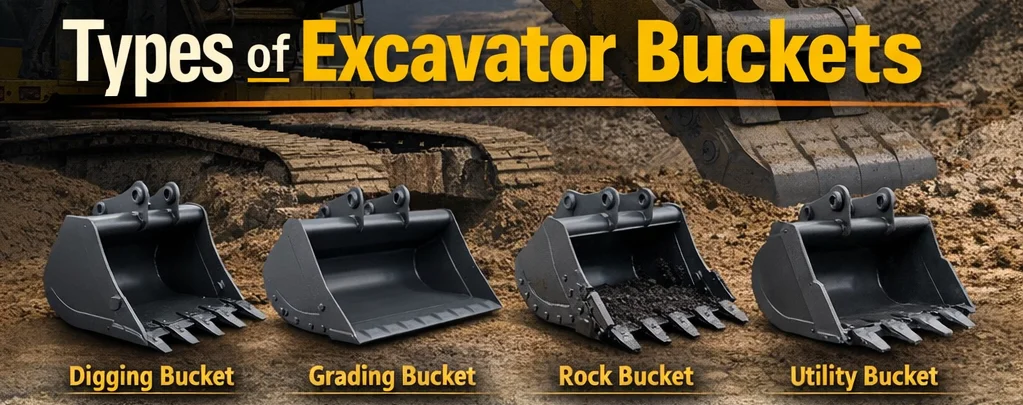
Excavator buckets are designed for specific soil conditions, materials, and job requirements. Choosing the correct bucket improves productivity, fuel efficiency, machine life, and job quality.
Below is a corrected, expanded, and industry-accurate classification of excavator buckets with general description, usage, application, advantages, material of construction, and typical capacity (m³).
1️⃣ Digging Bucket (General Purpose Bucket)


Description:
Standard bucket supplied with most excavators; fitted with teeth for penetration.
Usage:
General excavation and loading.
Applications:
Advantages:
Material of Construction:
Capacity:
0.1 – 5.0 m³ (depending on excavator size)
2️⃣ Grading Bucket (Leveling / Trimming Bucket)


Description:
Wide, flat-bottom bucket, usually without teeth.
Usage:
Surface finishing and leveling.
Applications:
Advantages:
Material of Construction:
Capacity:
0.2 – 4.0 m³
3️⃣ Rock Bucket (Heavy Duty Bucket)


Description:
Reinforced bucket with thick wear plates and strong teeth.
Usage:
Hard material excavation.
Applications:
Advantages:
Material of Construction:
Capacity:
0.5 – 3.5 m³
4️⃣ Utility Bucket

Description:
Multipurpose bucket between digging and grading type.
Usage:
Light excavation and cleanup.
Applications:
Advantages:
Material of Construction:
Capacity:
0.15 – 2.5 m³
5️⃣ Tilt Ditch Cleaning Bucket


Description:
Hydraulically tilting bucket (up to ±45°).
Usage:
Precision ditch shaping and cleaning.
Applications:
Advantages:
Material of Construction:
Capacity:
0.2 – 3.0 m³
6️⃣ Micro Trenching Bucket


Description:
Very narrow bucket for precise trenching.
Usage:
Utility and cable laying.
Applications:
Advantages:
Material of Construction:
Capacity:
0.03 – 0.3 m³
7️⃣ Frost Bucket


Description:
Bucket with long, pointed teeth for frozen or compacted ground.
Usage:
Breaking frozen soil layers.
Applications:
Advantages:
Material of Construction:
Capacity:
0.1 – 2.0 m³
8️⃣ Skeleton Bucket (Sieve / Screening Bucket)


Description:
Bucket with gaps between bars to separate materials.
Usage:
Sorting and screening.
Applications:
Advantages:
Material of Construction:
Capacity:
0.2 – 4.0 m³
9️⃣ V-Ditch Bucket (With Teeth)


Description:
V-shaped bucket fitted with teeth.
Usage:
Hard soil V-ditch cutting.
Applications:
Advantages:
Material of Construction:
Capacity:
0.1 – 1.5 m³
🔟 V-Ditch Bucket (Without Teeth)


Description:
Smooth cutting edge for soft soil.
Usage:
Final shaping of V-ditches.
Applications:
Advantages:
Material of Construction:
Capacity:
0.1 – 1.5 m³
1️⃣1️⃣ Rake / Riddle Bucket


Description:
Rake-type structure with tines.
Usage:
Clearing debris without soil removal.
Applications:
Advantages:
Material of Construction:
Capacity:
Material-based (not volume-focused)
1️⃣2️⃣ Clean-Up Bucket (Mud Bucket)


Description:
Wide bucket without teeth.
Usage:
Final cleaning and finishing.
Applications:
Advantages:
Material of Construction:
Capacity:
0.3 – 4.5 m³
🔧 Additional Important Bucket Types
📌 Conclusion
Excavator buckets are engineered tools, not accessories. Selecting the correct bucket:


📞 Contact Us for Electrify your Excavator – Loader
📍 Servoday Plants & Equipments Ltd
📞 +91 9427210483 | +91 9427210484
📧 sanjay@servoday.in
🌐 www.ElectricExcavator.in
👤 Contact Person: Sanjay Masuria
📲 WhatsApp: +91 9427210483
Strength, Precision, Reliability – Elevate Your Port Operations
genuinely serving since 1969. 🚀🔥