
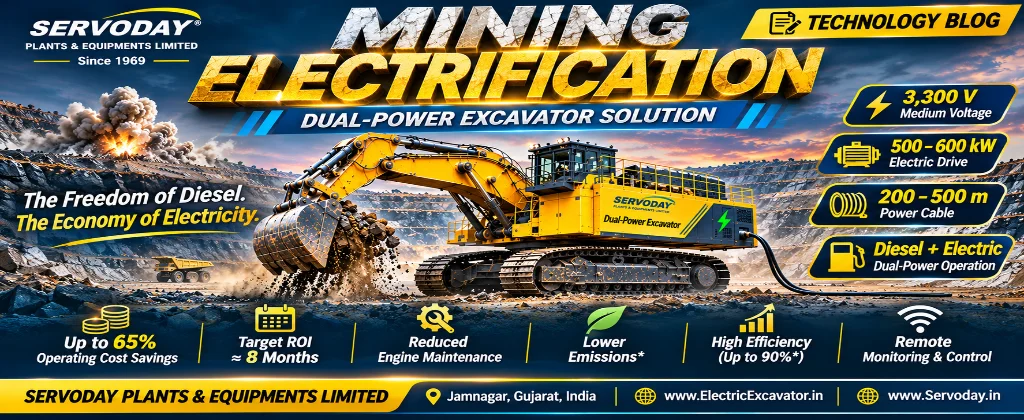
3,300 V Medium Voltage Electric + Diesel Technology
The Freedom of Diesel. The Economy of Electricity. One Powerful Mining Machine.
Technology by Servoday Plants & Equipments Limited | Designed for heavy-duty mining and earthmoving applications
Introduction

The future of heavy earthmoving and mining machinery is moving towards electrification. However, one major challenge continues to limit the adoption of conventional wired electric excavators: machine mobility and operational flexibility.
In mining operations, excavators frequently need to relocate because of blasting schedules, changing excavation faces, shifting working areas and other site requirements. Conventional wired electric excavators depend on external electrical connections, making relocation more complicated.
To address this real-world mining challenge, Servoday has developed an innovative Dual-Power Excavator Conversion Concept, combining conventional diesel operation with a high-power 3,300 V AC medium-voltage electric drive system.
Designed for large excavators in the 95-tonne class, this system allows operators to use economical external electricity for regular excavation and normal working functions, while retaining diesel power for independent machine mobility whenever required.
The system combines:
Our objective is simple: Electrify the machine without sacrificing the mobility that mining operations demand.
1. What Is a Dual-Power Excavator?
A dual-power excavator is a heavy-duty earthmoving machine designed to operate using two independent power sources:
Power Source 1 – External Electric Power
The excavator receives 3,300 V AC, three-phase, 50 Hz electrical power through a heavy-duty external cable. A medium-voltage VFD controls the electric motor’s speed and operating characteristics.
The electric drive supplies the power required for normal excavation and hydraulic working functions through the engineered power transmission arrangement.
Power Source 2 – Onboard Diesel Engine
The original diesel engine is retained to provide independent machine operation when external electrical power is not available or when the excavator needs to relocate.
This is particularly important in mining operations where the excavator must move away from a blasting zone.
The operator selects the required mode through a manual selector with automatic interlocks and the approved operating sequence.
The result: One excavator with two power options, designed to combine electric operating economics with diesel-powered mobility.
2. Why Did We Develop This Technology?
Our concept is based on practical experience with different types of excavators and heavy earthmoving equipment.
During our experience with mining machinery, we identified a recurring challenge associated with conventional cable-powered electric excavators.
The mining industry’s practical problem
Imagine an excavator working at a particular mining face.
With a conventional cable-dependent electric excavator, this process can become operationally complicated.
Other situations include:
Our engineering solution
Instead of designing an excavator that depends exclusively on electricity, we retained the original diesel power capability and integrated a separate electric drive arrangement.
This provides a practical alternative for mines that want to reduce diesel operating costs without losing machine mobility.
Our philosophy: Electric power for economical excavation. Diesel power for independent mobility.
3. Main Technical Specifications – 95-Tonne Dual-Power Excavator
The following specifications represent the proposed conversion configuration. Final equipment selection and ratings are subject to machine-specific engineering and commissioning.
| Technical parameter | Specification |
| Machine category | Heavy-duty hydraulic excavator |
| Machine operating class | Approximately 95 tonnes |
| Existing diesel engine | 400–500 HP |
| Electric motor | 500–600 kW |
| Electric supply voltage | 3,300 V AC |
| Supply phase | 3-phase |
| Supply frequency | 50 Hz |
| Electric motor control | Medium-voltage VFD |
| Motor speed | Variable RPM |
| Operating modes | Electric + Diesel |
| Mode selection | Manual selector |
| Interlocking | Automatic safety interlocks |
| External cable distance | 200–500 metres, design dependent |
| Cable conductor | High-conductivity copper |
| Remote connectivity | Wi-Fi / 4G / 5G |
| Monitoring controller | Intelligent industrial controller |
| Battery charging | Automatic 24 V DC |
| Control panel cooling | Air-conditioned |
| Retrofit concept | Customized plug-and-play design |
| Primary application | Mining and heavy earthmoving |
Important power-rating consideration
The 500–600 kW electric motor and 400–500 HP diesel engine are different power-source ratings. They should not be presented as identical output ratings.
For reference, 400–500 HP is approximately 298–373 kW. The final design must verify the hydraulic power requirement, simultaneous peak demand, efficiency, overload capability and duty cycle of the original excavator.
4. Advanced 3,300 V Medium-Voltage Electrical Technology
One of the most important differentiating features of our dual-power conversion technology is the use of a 3,300 V AC medium-voltage electric drive.
Large earthmoving machines require substantial power. Using a higher supply voltage can make high-power electrical transmission more practical.
Main engineering advantages

Why this matters
A 95-tonne excavator operating with a 500–600 kW electric drive requires careful electrical infrastructure planning.
Our medium-voltage approach focuses on reducing unnecessary current and optimizing the electrical connection between the mine’s power distribution system and the excavator.
The final cable size is determined by actual load current, cable length, permissible voltage drop, starting conditions, short-circuit withstand, thermal rating, installation method and mechanical requirements.
5. High-Performance Electric Motor and Variable Frequency Drive
The electric drive system is designed around a 500–600 kW, 3,300 V AC motor controlled through a suitable medium-voltage Variable Frequency Drive.
Unlike a conventional fixed-speed arrangement, the VFD enables variable motor speed according to the operating requirements.
Main features
Intelligent RPM management
Excavation work does not always require the same motor speed or power.
Different activities, such as digging, lifting, slewing and bucket unloading, have different hydraulic power requirements.
A properly engineered VFD control strategy can adjust motor speed according to demand.
Potential benefits include:
Our objective is to supply the hydraulic system with the power it requires, rather than unnecessarily operating the electric drive at full speed at all times.
6. Customized Hydraulic Power Transmission Arrangement
The hydraulic power transmission arrangement is one of the most important parts of the conversion project.
An excavator is fundamentally a hydraulic working machine. Its digging force, boom movement, arm movement, bucket operation, swing and travel functions depend on the hydraulic power system.
Therefore, converting a diesel excavator into a dual-power machine requires more than simply installing an electric motor.
The electric drive must be integrated with the excavator’s hydraulic system through a specially engineered mechanical and hydraulic arrangement.
Engineering considerations
The final coupling, gearbox or pump arrangement is customized according to the excavator model and the actual conversion architecture.
Full machine functionality
Our objective is to retain normal excavator working functions in electric mode, including:
The final commissioning process must verify that each required function operates within the original machine’s specified hydraulic pressure, flow, speed and load limits.
7. User-Friendly Dual-Power Switching System
One of the most important design objectives is making the system easy for excavator operators to understand and operate.
We incorporate a manual operating-mode selector supported by automatic safety interlocks.
Electric mode
When the excavator is connected to the external electrical supply and all safety conditions are satisfied:
Diesel mode
When the machine needs to relocate or work independently of the cable:
Dual-power operating philosophy
ELECTRIC
Regular excavation and normal working operations.
DIESEL
Independent mobility and operation when required.
The two power sources must be protected by a validated changeover and isolation arrangement. The machine must not travel with an energized cable connected unless a separately engineered system expressly permits it.
8. High-Conductivity Copper Power Cable System
Cable design is a critical part of a mobile medium-voltage excavator conversion.
Our design approach emphasizes high-conductivity copper conductors, suitable insulation and a robust cable arrangement.
Proposed cable operating distance
200–500 Metres
The planned cable distance offers flexibility in positioning the excavator within a mining working area, depending on the mine’s electrical infrastructure and cable routing.
Cable design requirements
Cable management
The cable must be properly routed and managed to avoid:
The cable size, reel or handling arrangement, connector system and voltage-drop limits must be finalized through engineering calculations.
9. Intelligent Wi-Fi / 4G / 5G Remote Monitoring System

Modern mining machinery requires more than basic electrical operation. Machine owners need to know how their equipment is performing, how much energy it is consuming and whether maintenance is required.
Our proposed intelligent controller provides remote monitoring through Wi-Fi and mobile network connectivity.
Live electrical monitoring
| Parameter | Monitoring purpose |
| Incoming voltage | Supply condition |
| Motor voltage | Motor electrical status |
| Current (A) | Load monitoring |
| Power (kW) | Real-time power demand |
| Energy (kWh) | Total electricity consumption |
| Power factor | Electrical performance |
| Frequency (Hz) | Drive operating frequency |
| Motor RPM | Speed monitoring |
| Motor temperature | Thermal condition |
| Panel temperature | Enclosure condition |
| Running hours | Machine utilization |
| Fault history | Troubleshooting |
Mobile and remote connectivity
Remote machine locking
An authorized administrator can initiate a remote machine lock command through a secure monitoring platform.
This feature can be useful for machine security and access management.
The lock function should use authenticated communication and safe-state logic. It must never stop a machine abruptly in a way that creates a hazard or override safety and emergency-stop systems.
Future smart features
We also recommend considering:
These features can make the excavator an intelligent, data-driven mining machine.
10. Air-Conditioned Medium-Voltage Electrical Control Panel

Mining conditions are often harsh, with dust, high temperatures, vibration and demanding operating environments.
The electrical control panel is therefore designed with appropriate enclosure protection and temperature management.
Main features
The cooling system must be selected according to the actual heat dissipation of the electrical equipment and the site’s ambient temperature.
11. Automatic 24 V DC Battery Charging System
The conversion package can incorporate an automatic 24 V DC battery charging arrangement to support the excavator’s existing low-voltage control and auxiliary electrical systems.
Main features
This helps maintain the machine’s control and auxiliary electrical supply while reducing the need for manual battery charging arrangements.
12. Plug-and-Play Retrofit Conversion Technology
One of the main objectives of our technology is to convert existing diesel-powered excavators rather than requiring customers to purchase entirely new electric machines.
Our customized retrofit philosophy focuses on retaining the original machine wherever technically practical.
Conversion process

Step 1 – Machine inspection
Study the excavator’s make, model, diesel engine, hydraulic pump system, electrical arrangement and operating requirements.
Step 2 – Engineering assessment
Calculate the required motor capacity, hydraulic power demand, drive arrangement, torque and operating RPM.
Step 3 – Electric motor integration
Select and install the appropriate medium-voltage motor and mechanical power transmission arrangement.
Step 4 – Medium-voltage electrical system
Install the 3,300 V electrical control system, VFD, protection devices and power cable connection arrangement.
Step 5 – Diesel/electric integration
Integrate the manual operating selector and automatic interlocks to ensure safe selection between the two power sources.
Step 6 – Intelligent controller integration
Install monitoring, energy metering, temperature sensors and communication facilities.
Step 7 – Testing and commissioning
Perform electrical, mechanical, hydraulic, functional and safety testing under the specified operating conditions.
Step 8 – Operator training
Provide training on electric operation, diesel operation, changeover, cable safety, fault response and routine maintenance.
Key objective
To provide a customized retrofit solution that makes existing heavy excavators suitable for dual-power operation while retaining their normal working capabilities.
13. Major Benefits for Mining Companies and Machine Owners
The main commercial advantage of our dual-power conversion system is the opportunity to reduce operating expenses while retaining the flexibility of diesel-powered machinery.
13.1 Up to 65% potential operating cost savings
Up to 65% Potential Savings
Electricity can be significantly more economical than diesel for suitable high-utilization mining applications.
Potential savings come from:
Actual savings depend on the diesel price, electricity tariff, machine loading, utilization and operating conditions.
13.2 Target ROI of approximately 8 months
Target Payback: 8 Months
Mining excavators generally represent substantial capital investments, and operating expenses can significantly affect project profitability.
Our dual-power system is intended to reduce these expenses through the use of electrical power for regular excavation.
The conversion investment can potentially be recovered through:
The eight-month payback is a target project outcome, not a guaranteed result. A machine-specific financial calculation is necessary before making this claim commercially.
13.3 Significantly reduced diesel engine maintenance
During electric operation, the diesel engine does not supply the excavator’s working power.
This can reduce:
The original diesel engine remains available, and its periodic servicing and maintenance must continue.
13.4 Reduced diesel dependency
For mines with a reliable electrical infrastructure, electric operation can reduce the need for regular diesel refuelling.
Benefits include:
13.5 High electric drive efficiency
The selected electric motor and drive system can be engineered for high efficiency, potentially 90% or higher depending on the equipment and operating point.
Advantages include:
The efficiency figure should be verified from the selected motor and VFD data sheets, and distinguished from overall electricity-to-hydraulic-system efficiency.
13.6 High torque and controlled operation

The medium-voltage VFD provides the capability to control motor speed and torque characteristics.
Potential benefits include:
We recommend using the phrase “High Torque and Stable Speed Control” rather than promising zero RPM drops under every load condition.
13.7 Reduced noise and local emissions
When the excavator operates in electric mode:
The environmental impact of electricity generation must also be considered.
13.8 Greater operational flexibility
Unlike a machine that depends entirely on external electricity, our dual-power concept retains diesel operation.
This provides additional flexibility during:
13.9 Improved energy cost predictability
By monitoring actual electrical consumption, mine operators can measure the energy cost of their excavator operations.
This helps in:
13.10 Potentially improved equipment availability
The availability of two power sources can reduce dependence on one operating arrangement.
If the external electrical supply is unavailable, diesel operation can be used, subject to the machine’s condition and approved changeover procedure.
14. Conventional Electric Excavator vs Dual-Power Excavator
The following comparison highlights the design philosophy of our conversion system.
| Comparison | Conventional wired electric | Servoday dual-power concept |
| Electric power | Yes | Yes |
| Diesel engine | Usually not available as working backup | Retained |
| External cable | Required | Required in electric mode |
| Independent diesel mobility | Generally unavailable | Available |
| Blasting relocation | Requires alternative arrangements | Diesel-powered relocation |
| Medium-voltage drive | Model dependent | 3,300 V design |
| Variable motor RPM | Model dependent | VFD controlled |
| Remote monitoring | Optional/model dependent | Integrated design offering |
| Remote machine locking | Model dependent | Proposed integrated feature |
| Retrofit existing machine | Model dependent | Primary objective |
| Operating flexibility | Cable dependent | Dual-power operation |
Our differentiation is the combination of high-power medium-voltage electrification and retained diesel mobility in one existing heavy-duty excavator.
15. Applications Across Mining and Heavy Earthmoving Industries
Our dual-power excavator conversion concept is suitable for evaluating a wide range of mining and earthmoving applications.
Mining applications
Industrial applications
Suitable machine categories
The current featured configuration is designed around the 95-tonne excavator class.
The technology may also be evaluated for other machine capacities, subject to customized engineering and feasibility assessment.
16. Electrical Safety, Protection and Engineering Standards
Operating a 3,300 V electrical system on mobile heavy machinery requires specialized engineering, testing and safety controls.
Our conversion philosophy must prioritize operator safety, equipment protection and electrical reliability.
Essential protection arrangements
Special attention to 3,300 V mobile electrical systems
The external electrical supply, cable coupler, cable routing, onboard control panel and motor must be designed as one integrated electrical system.
The design must address:
Applicable Indian electrical regulations and relevant IEC/IS standards should be identified during detailed engineering and certification.
17. Why Choose Servoday for Dual-Power Excavator Conversion?
Engineering experience. Practical innovation. Industrial solutions.
Servoday Plants & Equipments Limited, established in 1969, brings extensive industrial engineering and machinery experience to the development of customized heavy equipment solutions.
Our approach is based on identifying actual operating challenges and developing practical engineering solutions.
Our engineering priorities
We believe mining electrification must be practical, economical and flexible.
Our dual-power concept is designed to help mining companies move towards electric operation without losing the operational flexibility of diesel machinery.
18. Frequently Asked Questions
Q1. What is a dual-power excavator?
A dual-power excavator is a machine that can operate using both an external electric supply and its onboard diesel engine. It provides economical electric operation and independent diesel mobility.
Q2. What is the electric motor capacity of the 95-tonne excavator?
The proposed electric motor capacity is 500–600 kW, operating on a 3,300 V AC, three-phase, 50 Hz electrical system.
Q3. Does the original diesel engine remain installed?
Yes. The original 400–500 HP diesel engine is retained to provide the second operating power source.
Q4. Can the excavator perform normal excavation on electricity?
Yes. The electric drive is intended to support excavation and normal working functions through the customized hydraulic power transmission arrangement.
Q5. Can the machine relocate during blasting operations?
Yes. After safe electrical isolation and cable disconnection, the machine can operate on its diesel engine to relocate outside the designated blasting exclusion zone.
Q6. Why use 3,300 V instead of 415 V?
A 3,300 V system requires less current for equivalent power transmission, potentially reducing conductor requirements and cable losses.
Q7. What is the operating cable distance?
The proposed design considers approximately 200–500 metres, subject to cable selection, voltage drop and site conditions.
Q8. Can the motor operate at variable RPM?
Yes. The VFD provides variable-speed operation according to the machine’s power requirements.
Q9. Can the machine owner monitor electrical consumption remotely?
Yes. The proposed monitoring system can display voltage, current, kW, kWh, RPM, temperatures, running hours and fault information.
Q10. Is remote machine locking available?
An authorized remote locking function can be incorporated with secure access control and safe-state interlocks.
Q11. Can an existing diesel excavator be converted?
Yes, subject to a detailed technical assessment of the excavator’s mechanical, hydraulic and electrical systems.
Q12. How much can operating costs be reduced?
Potential operating cost savings can reach up to 65% in suitable applications. Actual savings depend on the machine’s operating conditions and energy prices.
Q13. What is the expected ROI?
An approximately eight-month payback is a target for suitable projects. A machine-specific cost and energy analysis is required to establish the actual payback.
Q14. Does the excavator require diesel when operating in electric mode?
The diesel engine is not required to supply the working power in electric mode, although the engine and associated systems remain installed and require appropriate maintenance.
Q15. Is this a new electric excavator or a retrofit system?
It is a customized retrofit concept designed to convert existing diesel-powered excavators into dual-power machines.
19. Conclusion – The Future of Mining Electrification Is Dual-Power
The mining industry requires machinery that is powerful, economical, reliable and flexible.
While electric excavators offer substantial operating cost advantages, conventional cable-dependent arrangements can create mobility challenges in dynamic mining environments.
Servoday’s dual-power excavator conversion concept addresses this challenge by combining 3,300 V medium-voltage electric technology with the retained diesel power system.
Designed around a 95-tonne excavator and a 500–600 kW electric motor, this system offers a practical approach to electrifying heavy earthmoving machinery.
Key highlights at a glance
95 T
Excavator class
500–600 kW
Electric motor
3,300 V
Medium-voltage supply
200–500 m
Planned cable distance
65%
Potential operating cost savings
8 Months
Target investment payback
The five defining advantages
One Machine. Two Power Sources. Greater Mining Flexibility.
We believe the future of heavy machinery is not simply about replacing diesel with electricity. It is about intelligently integrating both technologies to create a more economical and adaptable machine.
Electrify your excavator. Reduce operating costs. Retain your mobility.
20. About the Technology Developer
SERVODAY PLANTS & EQUIPMENTS LIMITED
Engineering Since 1969
Jamnagar, Gujarat, India
Servoday develops industrial machinery, customized engineering solutions and heavy equipment technologies.
Featured Technology: Dual-Power Diesel + Medium Voltage Electric Excavator Conversion.
Product & Technology Website: ElectricExcavator.in
Company Website: Servoday.in
21. Disclaimer and Technical Clarification
The information presented in this article describes the proposed dual-power excavator conversion technology and its intended features.
ElectricExcavator.in reserves the right to modify, improve, upgrade or change technical specifications, equipment configurations, designs and features without prior notice as part of continuous engineering development.


📞 Contact Us – Electrify Your Excavator & Loader
🏢 Servoday Plants & Equipments Limited
📍 Jamnagar, Gujarat, India
📞 Phone: +91 9427210483 | +91 9427210484
📧 Email: sanjay@servoday.in
🌐 Website: www.ElectricExcavator.in
👤 Contact Person: Sanjay Masuria
📲 WhatsApp: +91 9427210483
⚡ Switch to Electric Power – Reduce Fuel Costs, Zero Emission, Maximum Savings
Strength, Precision, Reliability – Elevate Your Port Operations
genuinely serving since 1969. 🚀🔥